Public Health Scotland (PHS) reports health data (click here for website) to:
- monitor NHS performance
- enable scientific research
- improve health outcomes
- guide the design of public services.
By doing so they provide the evidence base needed to better plan Scottish and Regional Health & Social Care Services.
PHS regularly update data but presents results (e.g. A&E Waiting Times, Ambulance Response Times, Delayed Discharges) at the regional level. Some datasets are available at the local level –e.g. practice list size, disease prevalence, but are not generally compared longitudinally to see the effects of population change.
Together in Health advocates for having all Health & Social Care datasets analysable at, or below the Post Code level to give local communities such as North Berwick Coastal Area enough rich, reliable information to understand the local pressures on health and social care that maybe amenable to innovative local interventions.
Below are some of the reports we have produced with our partners.
Ambulance Response Times
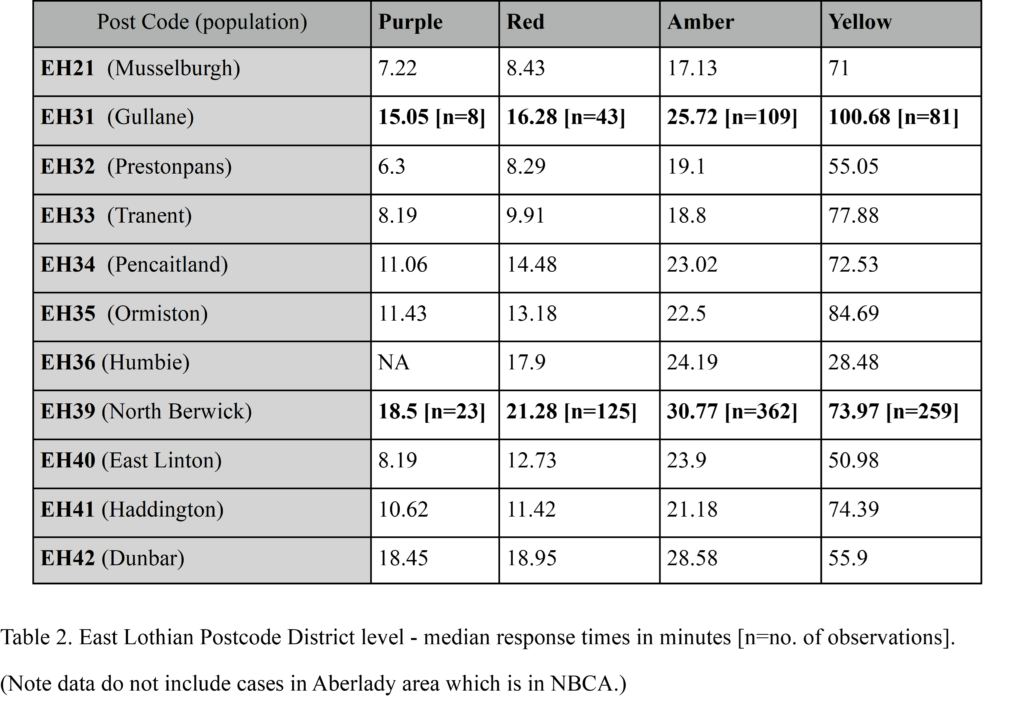
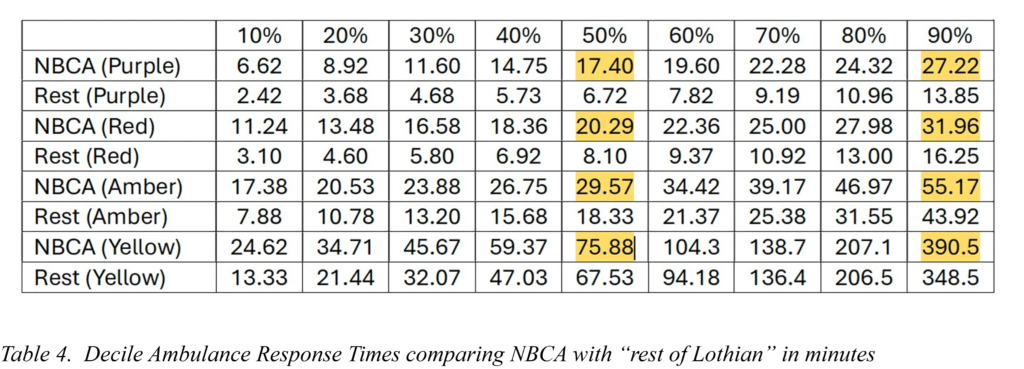
Together in Health analysed the Ambulance Response Time data in each Postcode area in East Lothian and identified that the more rural areas, furthest from A&E had response times for life threatening calls, twice that of other East Lothian areas and twice the national target times (click here for report). You can read highlights of the report in this summary: (click here for summary).
Two of the key tables from the report, illustrating ambulance response times, are shown below.
Prof Sarah-Ann Munoz, Head of Research & Evaluation at National Centre for Rural & Remote Health and Care, said the report was “very helpful, particularly in showing the value of more local analysis and the extent to which broader regional reporting can mask important within-region variation”.
Building on the report and analysis, Together in Health is collaborating with partners to develop an Acute Healthcare Resilience programme.
The shared central goal of this collaboration is to significantly improve survival rates for ‘Out of Hospital Cardiac Arrest (OHCA)’ across the North Berwick Coastal Area by combining rapid community response, strategic defibrillator placement, and a guaranteed local supply chain for parts. Three distinct organisations have formed a unified “Chain of Survival.” The 3 pillars of collaboration are:
- Community Resilience Response
-
- Lead: North Berwick Community First Responders
- Focus: Training local citizens in CPR and defibrillator use.
- Focus: Providing rapid, on-scene medical assessment to OHCA
- Focus: Empowering bystanders to act confidently.
- Defibrillator Infrastructure and Meeting Coordination
-
- Lead: Together in Health Defibrillator group
- Focus: Strategic placement of new devices.
- Focus: Maximising cabinet visibility and signage.
- Focus: Ensuring 24/7 public rescue access.
- Focus: Coordination of joint CPR / Defibrillator Training Sessions
- Supply Chain & Maintenance
-
- Lead: North Berwick Coastal Area Partnership
- Focus: Coordinating central funding for consumables.
- Focus: Monitoring and replacing expired batteries.
- Focus: Distributing fresh defibrillator electrode pads.